Tesla Shareholders Approve Musk's $1 Trillion Pay Package: Market Impact and Governance Analysis
解锁更多功能
登录后即可使用AI智能分析、深度投研报告等高级功能
关于我们:Ginlix AI 是由真实数据驱动的 AI 投资助手,将先进的人工智能与专业金融数据库相结合,提供可验证的、基于事实的答案。请使用下方的聊天框提出任何金融问题。
相关个股
Tesla shareholders approved CEO Elon Musk’s historic $1 trillion performance-based pay package with over 75% voting support at the company’s annual shareholders meeting in Austin, Texas on November 6, 2025 [1][2][3]. The vote results were announced at 5:39 PM EST, marking a significant victory for Musk despite opposition from major proxy advisors and some institutional investors.
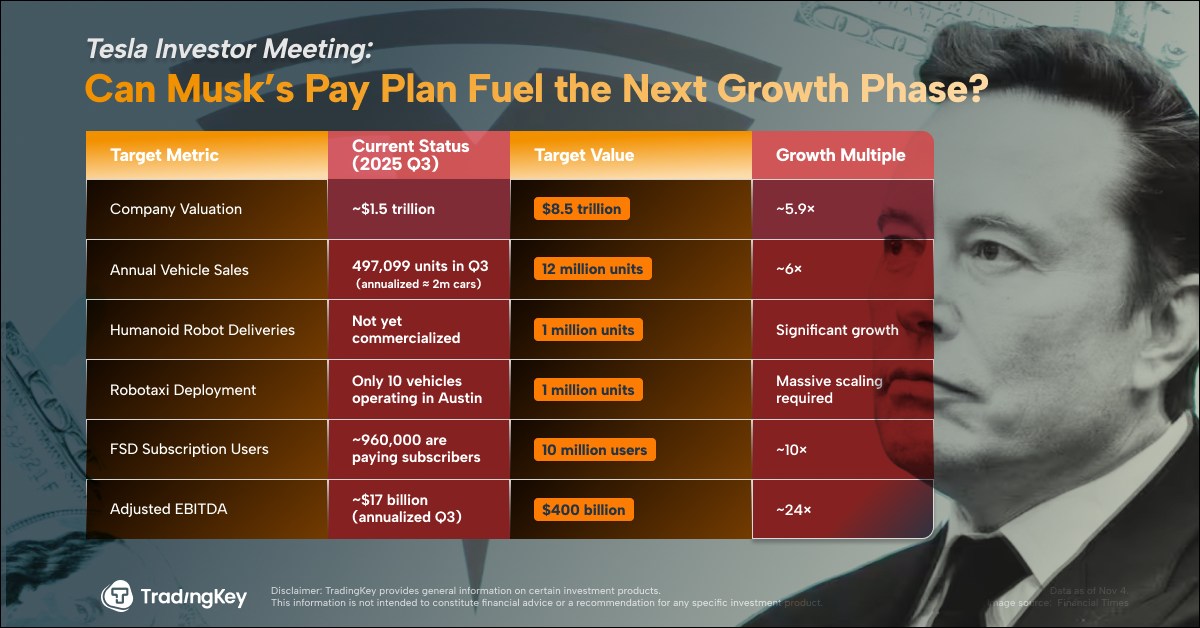
The compensation package consists of 12 tranches of shares totaling up to 423 million shares, potentially increasing Musk’s ownership stake from approximately 13% to 25% and boosting his voting power to around 25% of the company [1][3]. The plan requires Tesla to achieve extreme milestones over the next decade, including reaching $8.5 trillion in market capitalization (nearly 6x the current $1.44 trillion market cap) [1][3].
Tesla’s stock showed mixed reactions following the vote announcement, closing at $445.91 (-3.50% on the day) with a daily range of $435.09 - $467.45 [0]. Trading volume reached 104.87 million shares, above the average of 86.91 million [0]. While some reports indicated shares rose 2% immediately after the vote announcement [2], the stock ultimately closed lower amid broader market weakness.
The decline occurred within a challenging sector environment, with the Consumer Cyclical sector down 2.14% and Technology sector down 1.59% [0]. This suggests Tesla’s performance was partly influenced by sector-wide headwinds rather than solely company-specific factors related to the compensation vote.
The $1 trillion package is structured around multiple milestone categories [1][3]:
- 1st tranche: $2 trillion market cap
- Next 9 tranches: $500 billion increments up to $6.5 trillion
- Final 2 tranches: $1 trillion increments to $8.5 trillion
- 20 million vehicle deliveries (Tesla has delivered ~8 million to date)
- 10 million active FSD subscriptions
- 1 million Optimus robots delivered
- 1 million robotaxis in commercial operation
- Annual adjusted profit targets from $50 billion to $400 billion
- Q3 2025 adjusted EBITDA was $4.2 billion [1]
The targets require extraordinary growth - approximately 491% increase in market capitalization from current levels and scaling vehicle deliveries by 150% from current cumulative totals.
Major proxy advisors strongly opposed the package:
- ISS and Glass Lewis: Both recommended voting against the plan [1][3]
- Norway’s Sovereign Wealth Fund: Voted against, citing concerns about “award size, dilution, and lack of mitigation of key person risk” [1]
- CalPERS: Also voted against the package [1]
Criticism focused on excessive compensation relative to company performance, significant dilution of existing shareholders (423 million new shares), and broad “covered events” clauses allowing payouts even if targets are missed [1][3]. These covered events include natural disasters, wars, pandemics, changes in laws, and governmental actions that could hamper Tesla’s operations. Reuters reported that Musk could still receive “tens of billions of dollars without meeting most of the targets” [1].
The approval creates significant governance implications through the concentration of voting power. Musk’s potential 25% voting stake raises concerns about shareholder oversight capabilities and potential for related party transactions with his other companies (SpaceX, xAI, Neuralink). This concentration occurs amid Musk’s increasing political activities and multiple business commitments.
This vote follows the Delaware Court of Chancery’s ruling last year that Musk’s 2018 pay plan was improperly granted and must be rescinded [1]. Musk appealed that ruling, and the matter is pending before the Delaware State Supreme Court, creating legal uncertainty around both compensation packages and potentially affecting the enforceability of the newly approved plan.
Tesla faces intensifying competition across multiple fronts while pursuing these ambitious targets. Traditional automakers are accelerating EV programs, Waymo and Cruise are advancing robotaxi services, and major tech companies are investing heavily in AI and robotics technologies similar to Tesla’s initiatives.
The concentration of voting power in Musk’s hands (potentially 25%) raises significant governance concerns that warrant careful consideration. Reduced shareholder oversight capabilities and potential conflicts of interest with Musk’s other ventures represent substantial governance risks.
The dilution from 423 million new shares represents approximately 13% of current shares outstanding, significantly impacting existing shareholders’ ownership percentages [1]. The $8.5 trillion market cap target requires unprecedented growth, while Tesla’s current valuation (P/E: 234.69x) already reflects high growth expectations [0].
Key execution challenges include regulatory approval and safety validation for fully autonomous driving technology, regulatory hurdles for robotaxi operations, manufacturing Optimus robots at scale with commercial viability, and sustaining growth in increasingly competitive EV markets.
The pending Delaware Supreme Court decision on the 2018 pay package creates legal uncertainty. Additionally, increased antitrust scrutiny of large tech companies and potential regulatory headwinds from Musk’s political activities represent ongoing risks.
Key metrics to watch include quarterly FSD subscription growth reports, regulatory approvals and commercial launch timelines for robotaxi deployment, vehicle delivery progress toward the 20 million target, market share trends in EV and autonomous driving sectors, and major shareholder positions and voting patterns.
This analysis is based on the CNBC report [1] published on November 6, 2025, which covered Tesla’s shareholder vote on Musk’s compensation package. The vote represents an extraordinary corporate governance event with significant implications for shareholder value and company direction.
Critical information gaps remain, including detailed vote breakdowns between institutional and retail shareholders, specific definitions of covered events clauses, current FSD subscription metrics, robotaxi deployment timelines, and detailed analysis of board member relationships and potential conflicts of interest.
The compensation package’s structure includes extensive risk mitigation provisions that could enable substantial payouts even if operational targets are not met, raising questions about the performance-based nature of the compensation. The combination of ambitious targets, governance concentration, and regulatory uncertainty creates a complex risk profile for Tesla shareholders.
数据基于历史,不代表未来趋势;仅供投资者参考,不构成投资建议
关于我们:Ginlix AI 是由真实数据驱动的 AI 投资助手,将先进的人工智能与专业金融数据库相结合,提供可验证的、基于事实的答案。请使用下方的聊天框提出任何金融问题。