Tesla's Strategic Pivot: Reassessing Valuation from EV to AI/Robotics Platform
解锁更多功能
登录后即可使用AI智能分析、深度投研报告等高级功能

关于我们:Ginlix AI 是由真实数据驱动的 AI 投资助手,将先进的人工智能与专业金融数据库相结合,提供可验证的、基于事实的答案。请使用下方的聊天框提出任何金融问题。
相关个股
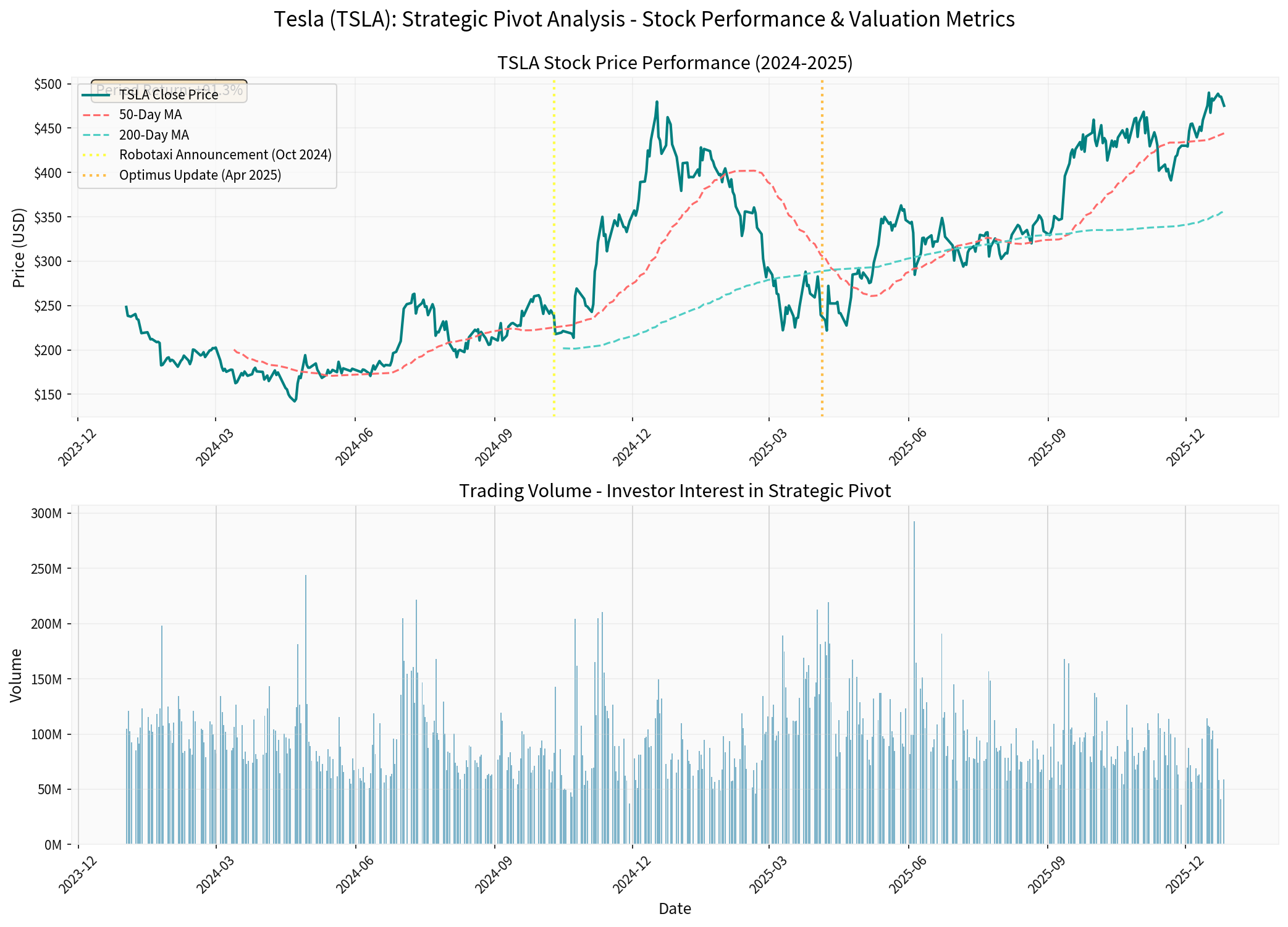
Tesla is undergoing a fundamental transformation from an electric vehicle manufacturer to an AI and robotics company. With its market capitalization at $1.53 trillion[0] and stock up 90% over the past two years[0], investors are already pricing in this strategic shift. However, the current valuation presents a complex challenge: Tesla’s P/E ratio of 291x[0] reflects extraordinary growth expectations, yet 78.9% of revenue still comes from automotive sales[0].
This analysis examines how investors should reassess Tesla’s valuation framework as the company pivots toward robotaxis and Optimus humanoid robots.
Metric |
Value |
Analysis |
|---|---|---|
| Market Cap | $1.53 trillion | Among “Magnificent Seven” tech giants |
| Current Price | $475.19 | Near 52-week high of $498.83 |
| P/E Ratio | 291.09x | Extremely high vs traditional automakers (5-15x) |
| P/B Ratio | 19.18x | Reflects intangible value expectations |
| Revenue (FY2024) | ~$95B | 75% from EV sales, declining for second year[2] |
| Net Margin | 5.51% | Constrained by heavy R&D investment |
| Free Cash Flow | $3.58B | Limited by capex for AI/robotics infrastructure |
- 2-Year Return:+90.02% (significantly outperforming S&P 500)
- YTD 2025:+25.29%
- 52-Week Range:$214.25 - $498.83 (132% range)
- Volatility:4.00% daily standard deviation
The stock’s dramatic 2024-2025 rally coincides with Tesla’s increased emphasis on AI and robotics initiatives, suggesting investors have already begun repricing the company as a technology platform rather than a traditional automaker[1].
- EV sales declining for second consecutive year in 2025[2]
- Intense competition from Chinese manufacturers (69% market share)[3]
- Margin pressure from price wars
- Still generates ~75% of current revenue[2]
- If valued solely as EV maker: Worth roughly $150-200B
- Implied AI/Robotics Premium:$1.3+ trillion
- Operating in Austin without human safety monitors (as of late 2025)[1]
- Analysts expect fleet to grow from low-hundreds to ~1,000 vehicles by 2026[1]
- Targeting expansion to 30+ U.S. cities in 2026[2]
- Wedbush analyst Dan Ives projects robotaxis could become a “mega-product” eclipsing Tesla’s entire automotive segment[1]
- Bull case scenario: Could drive Tesla to $2-3 trillion market cap by 2026[2]
- Revenue model: Per-mile fees vs vehicle ownership (higher margins than manufacturing)
- Waymo (Alphabet):Only operator providing fully driverless service across multiple U.S. cities; ~150,000 weekly paid rides by late 2024; targeting 1M weekly rides[4]
- GM Cruise & Amazon Zoox:Limited fare-free trials, smaller scale[4]
- Tesla’s Advantage:Lower sensor costs (~$400 vs Waymo’s $12,650 per vehicle)[4]; massive existing fleet for data collection
- Tesla’s Challenge:Still reliant on human supervision in many deployments; Waymo already fully unsupervised[4]
- If robotaxis generate $10-20B in high-margin revenue by 2027: Worth $200-400B
- In development/testing phase
- Elon Musk predicts it could make Tesla “the most valuable company in the world”[1]
- Morgan Stanley added $60/share in equity value from humanoid robotics in sum-of-the-parts analysis[3]
- Humanoid robotics market potentially worth hundreds of billions by 2030s
- Industrial automation, manufacturing, logistics applications
- Competitors: Figure AI, Unitree (Chinese company), Boston Dynamics (less commercial focus)[5]
- Limited production/testing in 2025-2026
- Volume manufacturing unlikely before 2027-2028
- Meaningful revenue contribution post-2028
- Current valuation assumes 100% success in commercialization
- Realistically worth $100-300B in optimistic scenario, $0-50B in base/bear case
Metric                  Traditional Auto Multiple    Tesla Current (Dec 2025)
----------------        -------------------------    ------------------------
P/E Ratio               5-15x                        291x
Price/Sales             0.5-2x                       ~16x
EV/Revenue              0.5-2x                       ~16x
EV/EBITDA               6-12x                        ~97x
Implied Market Cap      $100-200B                    $1.53T
Morgan Stanley’s recent analysis adopted this approach[3]:
Business Segment |
Base Case Value |
Bull Case |
Bear Case |
Multiple Type |
|---|---|---|---|---|
| Legacy Auto/EV | $100-150B | $200B | $50-75B | 5-10x EBITDA |
| Energy Storage | $30-50B | $80B | $15-20B | 10-15x EBITDA |
| Robotaxis (FSD) | $300-500B | $800B-1T | $100-200B | Platform multiple |
| Optimus (Humanoid) | $150-250B | $500B | $0-50B | Option value |
TOTAL SOTP |
$580-950B |
$1.58-2.8T |
$165-345B |
|
Current Market Cap |
$1.53T |
|||
Upside/Downside |
+60% to -85% |
+0% to +83% |
-89% to -77% |
If valued as an AI/robotics platform company (comparable to Nvidia, Alphabet, cloud platforms):
Metric                  Platform Company         Tesla Current
                        Range                    (Dec 2025)
----------------        ----------------         -------------
Price/Sales (Forward)   8-15x (hypergrowth)     TBD (dependent on new revenue streams)
EV/Revenue              10-20x                   ~16x current
Growth Rate Required    30-50% CAGR              Unclear transition period
- Robotaxi fleet reaches 50,000+ vehicles by 2027
- $15-25B in high-margin robotaxi revenue (80%+ gross margin)
- Optimus enters limited production, $5-10B revenue by 2028
- EV business stabilizes at $80-90B revenue
- Total revenue: $120-140B by 2028, 30%+ CAGR
- Margins expand to 15-20% on software/platform revenue
- Robotaxi deployment proceeds but slower: 5,000-10,000 vehicles by 2027
- $3-5B in robotaxi revenue by 2027
- Optimus still pre-revenue or minimal commercialization
- EV business declines modestly to $70-80B
- Total revenue: $90-100B by 2028, flat vs current
- Margins compressed by continued investment
- Robotaxi commercialization delayed or fails to achieve scale
- Optimus remains experimental/limited
- EV business continues declining to $60-70B
- Revenue: $80-90B, declining
- Margin pressure from price wars, high R&D
- Autonomous Driving:Tesla’s vision-based approach vs Waymo’s LiDAR/map-based strategy; Tesla behind in fully unsupervised deployment[4]
- Regulatory Hurdles:Robotaxi approvals city-by-city; safety incidents could derail expansion
- Liability Issues:Accident liability framework still evolving
- Waymo:Technologically ahead, fully operational in multiple cities, backed by Alphabet’s resources[4]
- Chinese Competitors:BYD, others in EVs; Chinese humanoid robotics companies emerging[5]
- Tech Giants:Alphabet, Meta, Amazon investing heavily in AI/robotics
- Capital Intensity:Robotaxi fleet requires massive capex
- Manufacturing Complexity:Optimus mass production at scale unproven
- Management Bandwidth:Elon Musk distracted by X (Twitter), SpaceX, other ventures
- Already Priced to Perfection:At 291x P/E, limited margin for error
- Execution Gaps:Any delay in robotaxi/Optimus could trigger 30-50% correction
- EV Decline:Core business deterioration not fully priced in
-
Is Tesla an AI company or an automaker?
- Current reality: 75% automaker, 25% option value on future
- Market pricing: Treating as AI/platform company
- Gap:Misalignment between current fundamentals and valuation
-
What probability of success is priced in?
- At $1.53T, implies 60-70%+ probability of robotaxi success AND 40-50%+ probability of Optimus success
- Historical tech platform success rates: <20% achieve expectations
- Verdict:Expectations likely too high
-
What are the catalysts and timeline?
- Near-term (2026):Robotaxi fleet expansion to 30 cities, production volume ramp[2]
- Mid-term (2027):Proof of robotaxi unit economics (profitability per vehicle)
- Long-term (2028+):Optimus commercialization
- Risk:Long investment horizon with limited near-term catalysts
-
How to monitor progress?
- Robotaxi Metrics:Fleet size, rides/week, utilization rates, revenue/vehicle
- FSD Take Rate:Percentage of Tesla owners subscribing to FSD software
- Optimus:Production prototypes, pilot deployments, commercial agreements
- EV Business:Stabilization of deliveries and margins
-
Take Profits on Partial Position:At $475, stock prices in significant success across all new initiatives. Consider trimming 20-30% of holdings to lock in gains and reduce exposure to execution risk.
-
Monitor Key Catalysts:
- Q1 2026: Update on 30-city robotaxi expansion progress[2]
- Q2 2026: Initial robotaxi fleet economics data
- Q4 2026: Optimus commercialization timeline
-
Set Stop-Loss Levels:Given 132% 52-week range[0] and high volatility, consider protective stops at $380-400 to limit downside to 15-20%.
-
Wait for Better Entry Point:At 291x P/E, risk/reward unfavorable. Wait for:
- Pullback to $350-400 range (more reasonable valuation)
- Concrete robotaxi revenue data (Q2 2026+)
- Stabilization of core EV business
-
If Buying Now:
- Treat as venture capital investment in AI/robotics
- Expect 3-5 year holding period
- Position size: 2-5% of portfolio maximum
Hedge with Put Options:Given volatility, consider protective puts or buy-write strategies
-
Adopt Sum-of-the-Parts Valuation:Model robotaxis, Optimus, and EV as separate businesses with distinct multiples[3]
-
Scenario Analysis:Assign probabilities to bull/base/bear cases; expected value calculation at current price suggests modest downside risk (-10% to -20% if using reasonable probability weights)
-
Peer Group Comparison:Compare to:
- Traditional Auto:GM, Ford (5-8x P/E)
- EV Pure Plays:Rivian, Lucid (pre-profit, growth multiples)
- AI/Platforms:Alphabet, Nvidia (25-35x P/E on high growth)
- Ride-Hailing:Uber, Lyft (2-3x revenue, negative earnings)
Conclusion:Tesla trades at premium to all comparables
Tesla faces a fundamental
- If valued as automaker:Worth $150-200B (85-90% downside)
- If valued as AI/platform company:Needs to prove hypergrowth from new segments
- Current reality:Market pricing it as AI company before new businesses have generated material revenue
Timeline |
Milestone |
Current Status |
Confidence |
|---|---|---|---|
| Q1 2026 | Robotaxi expansion to 30 cities announced | Planning stage | Medium |
| Q2 2026 | Fleet grows to 1,000+ vehicles | ~500 currently | Medium |
| Q3 2026 | First positive unit economics data | Unproven | Low |
| Q4 2026 | $1B+ robotaxi revenue run rate | ~$0 currently | Low |
| 2027 | Optimus enters limited production | Testing phase | Very Low |
| 2028 | Robotaxi revenue >$10B | Speculative | Very Low |
[0]
[1]
https://finance.yahoo.com/news/800-tesla-stock-could-reality-143002634.html
[2]
https://finance.yahoo.com/news/golden-goose-could-tesla-3-023056178.html
[3]
https://finance.yahoo.com/news/tesla-sky-high-valuation-prompts-160032022.html
[4]
https://www.forbes.com/sites/greatspeculations/2025
数据基于历史,不代表未来趋势;仅供投资者参考,不构成投资建议
关于我们:Ginlix AI 是由真实数据驱动的 AI 投资助手,将先进的人工智能与专业金融数据库相结合,提供可验证的、基于事实的答案。请使用下方的聊天框提出任何金融问题。