Activist Investor Stake-Building in Target: Strategic Changes & Investment Implications
解锁更多功能
登录后即可使用AI智能分析、深度投研报告等高级功能
关于我们:Ginlix AI 是由真实数据驱动的 AI 投资助手,将先进的人工智能与专业金融数据库相结合,提供可验证的、基于事实的答案。请使用下方的聊天框提出任何金融问题。
相关个股
| Company | Stake Size | Outcome |
|---|---|---|
Kenvue (KVUE) |
Significant | Acquired by Kimberly-Clark for $40B (Nov 2025) |
Kellanova |
Strategic stake | Pushed for operational changes at Pringles maker |
US Steel |
Active position | Advocated for strategic alternatives amid acquisition interest |
According to
- Net sales declined -1.5%year-over-year
- Comparable sales fell -2.7%
- Three consecutive quarters of declining comparable sales[1]
| Metric | Value |
|---|---|
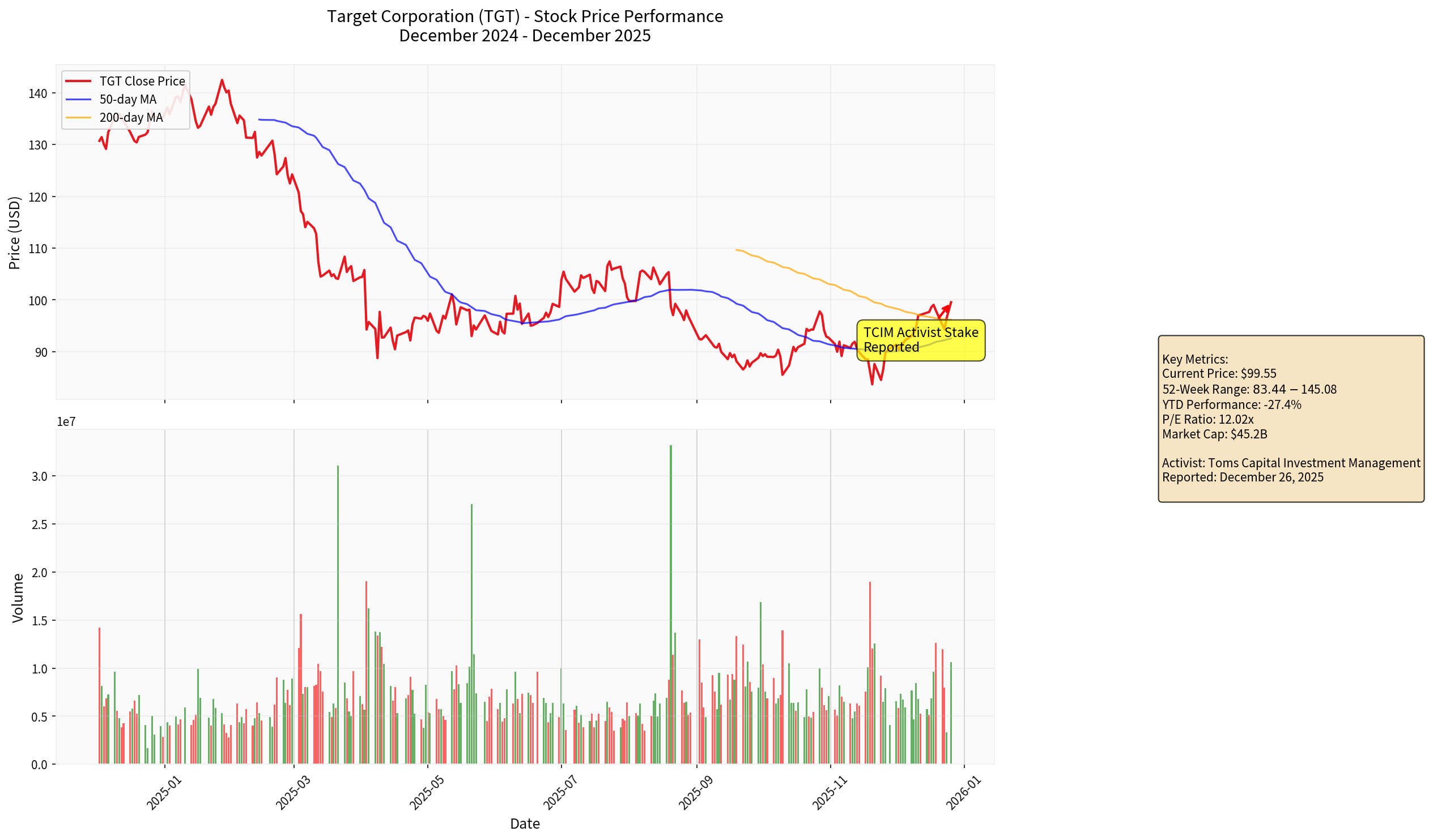
| 52-Week High | $145.08 |
| Current Price | $99.55 |
| YTD Decline | -27.4% |
| 3-Year Decline | -31.6% |
| 5-Year Decline | -43.6%[0] |
| Metric | Value | Assessment |
|---|---|---|
| P/E Ratio (TTM) | 12.02x | Below historical average |
| Market Cap | $45.2B | Down significantly from highs |
| P/B Ratio | 2.92x | Reasonable for retail |
| ROE | 24.87% | Strong profitability[0] |
Based on TCIM’s historical approach and typical retail activist campaigns, the following strategic changes are likely:
- Further corporate workforce reductions (Target already cut 1,800 roles in October 2025)
- Supply chain optimization and inventory management improvements
- Store footprint rationalization
- Administrative expense reductions
- Addition of activist-nominated directors with retail expertise
- Potential removal of long-tenured directors
- Enhanced board diversity and independence
The Accountability Board has already filed a shareholder proposal urging Target to appoint an
- Real estate monetization (Target owns significant store properties)
- Non-core business divestitures
- Strategic alternatives for underperforming segments
- Increased share buybacks
- Dividend policy review
- Rebalancing capital expenditures
- Debt optimization
- Accelerated management transitions
- Enhanced accountability for performance
- Possible addition of turnaround specialists
- Upside Potential:DCF analysis suggests significant upside with:
- Conservative fair value: $296.23(+197.6%)
- Base case fair value: $375.58(+277.3%)
- Probability-weighted value: $412.23(+314.1%)[0]
- Conservative fair value:
- Technical Position:Stock currently trades in sideways range ($94.95 - $100.96) with potential for breakout[0]
- Analyst Sentiment:Consensus rating of HOLD with 44.8% Buy ratings; price target $92.00[0]
- Volatility during activist campaign
- Potential public disagreements between TCIM and management
- Execution risk on operational changes
- Consumer spending weakness and tariff headwinds[1]
| Scenario | Probability | Shareholder Impact |
|---|---|---|
Cooperative Engagement |
50% | Gradual operational improvements, 20-40% upside |
Aggressive Campaign |
30% | More radical changes, higher volatility, 30-60% upside |
Resistance & Stalemate |
15% | Limited progress, stock remains range-bound |
Full Proxy Contest |
5% | Significant disruption, binary outcome |
- Digital/e-commerce accelerationto compete with Amazon and Walmart
- Private label expansion(Target’s owned brands account for ~30% of sales)
- Same-day delivery and fulfillment optimization
- Loyalty program enhancement
- Format innovation(small-format stores, urban locations)
| Company | Activist | Outcome | Shareholder Return |
|---|---|---|---|
Kohl’s (2022) |
Ancora/Legion/Macellum | CEO replacement, board refresh | Mixed - operational focus, but sales challenges persisted |
Bed Bath & Beyond |
Ancora/Legion | Board overhaul | Negative - bankruptcy (2023) |
JCPenney |
Various (2010s) | Multiple campaigns | Negative - bankruptcy (2020) |
Target (2009) |
Pershing Square | Real estate spin-off rejected | Mixed - shareholder vote supported management[1][3] |
- Activism does not guarantee success; execution and market conditions matter
- Retail turnarounds are particularly challenging in e-commerce era
- Governance changes alone cannot offset secular headwinds
- Cooperate engagement typically yields better outcomes than proxy fights
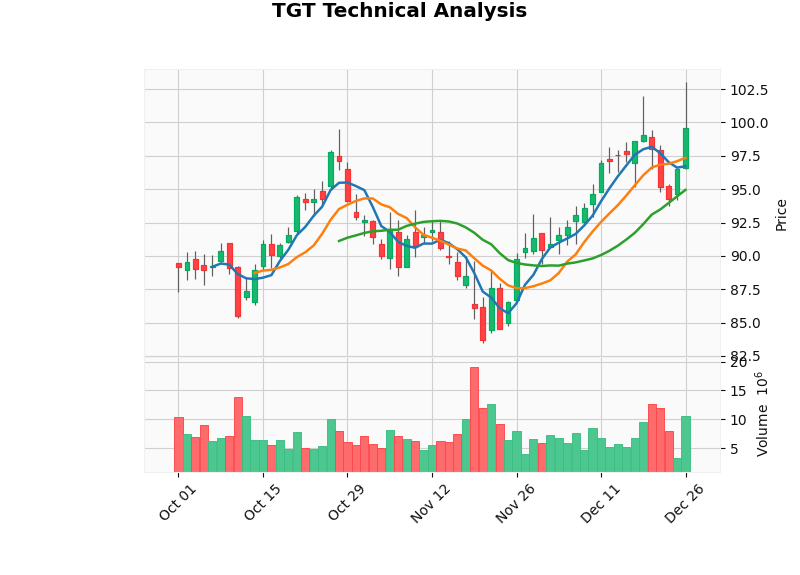
- Trend:Sideways/no clear trend
- Support:$94.95 (20-day moving average)
- Resistance:$100.96 (recent highs)
- Volume:Elevated on activist news (10.47M vs. 7.66M average)
- Beta:1.12 (higher volatility than market)
- Break above $105 would signal bullish momentum
- Support at $90 (November 2024 lows)
- Major support at $83.44 (52-week low)
- Strong ROE:24.87% indicates efficient capital use
- Reasonable valuation:P/E of 12.02x below 5-year average
- Established brand:Target remains a destination for value-conscious consumers
- Free cash flow:$4.48B (latest) provides flexibility
- Debt risk classified as HIGHby financial analysis
- Current ratio:0.97 (slightly below 1.0, indicates liquidity pressure)
- Quick ratio:0.27 (very low, indicates short-term liquidity concerns)
- 12 consecutive quartersof sales decline
- Significant undervaluation according to DCF analysis (up to 314% upside potential)[0]
- Activist involvement creates catalyst for value realization
- Target’s core franchise remains strong with owned brands and experiential retail
- New CEO (Fiddelke) may bring fresh perspective
- Consumer spending weakness in 2026
- Potential escalation costs if TCIM pursues proxy contest
- Competitive pressure from Walmart and Amazon
- Tariff and inflation headwinds
| Strategy | Entry Price | Target | Rationale |
|---|---|---|---|
Conservative |
<$90 | $110-125 | Attractive risk/reward if activist campaign succeeds |
Moderate |
$95-100 | $130-160 | Fair value considering activist catalyst |
Aggressive |
Current | $175+ | Assumes successful turnaround and multiple expansion |
- January-February 2026: TCIM may file 13DorSchedule 13Gdisclosing stake size
- February 1, 2026: CEO transition (Cornell → Fiddelke)
- Q4 2025 earnings release: First quarterly results under activist scrutiny
- Potential board refresh announcements
- Strategic review announcements
- Possible restructuring initiatives
- Shareholder meeting season (May-June 2026) - potential proxy contest if demands not met
The entry of
- DCF analysis indicates fair value potentially 3x-5x current price[0]
- TCIM’s track record shows ability to unlock value (Kenvue sale, Kellanova improvements)
- Target’s strong brand and owned-portfolio provide turnaround potential
- Retail sector faces structural challenges from e-commerce and discounters
- Consumer spending headwinds in 2026
- Target already initiated restructuring (1,800 job cuts announced October 2025)
- Cooperation vs. confrontation dynamic remains uncertain
- Current shareholders:Hold with position sizing appropriate for turnaround risk
- New investors:Opportunistic entry on weakness with clear exit strategy
- Risk tolerance:Moderate-High given execution and sector risks
The activist stake creates a
[0] 金灵API Data (Stock quotes, technical analysis, financial analysis, DCF valuation, and price data)
[1] PYMNTS.com - “Activist Investor TCIM Makes ‘Significant’ Investment in Target” (https://www.pymnts.com/news/2025/activist-investor-tcim-makes-significant-investment-in-target/)
[2] Financial Times via 13D Monitor - “Pressure Grows on Target as Activist Investor Builds Stake” (https://www.13dmonitor.com/DefaultUS.aspx)
[3] Harvard Law School Forum on Corporate Governance - “The Recent Evolution of Shareholder Activism in the United States” (https://corpgov.law.harvard.edu/2025/12/24/the-recent-evolution-of-shareholder-activism-in-the-united-states/)
[4] AOL/Reuters - “Embattled Target Feeling Heat from Hedge Fund Investor Toms Capital” (https://www.aol.com/articles/embattled-target-feeling-heat-hedge-165142817.html)
[5] Yahoo Finance - “Target Shares Gain as Activist Investor Reportedly Builds Big Stake” (https://finance.yahoo.com/news/target-shares-gain-activist-investor-154111204.html)
数据基于历史,不代表未来趋势;仅供投资者参考,不构成投资建议
关于我们:Ginlix AI 是由真实数据驱动的 AI 投资助手,将先进的人工智能与专业金融数据库相结合,提供可验证的、基于事实的答案。请使用下方的聊天框提出任何金融问题。