Wood Group's UK T&D Business Sale: Strategic and Valuation Impact Analysis
解锁更多功能
登录后即可使用AI智能分析、深度投研报告等高级功能
关于我们:Ginlix AI 是由真实数据驱动的 AI 投资助手,将先进的人工智能与专业金融数据库相结合,提供可验证的、基于事实的答案。请使用下方的聊天框提出任何金融问题。
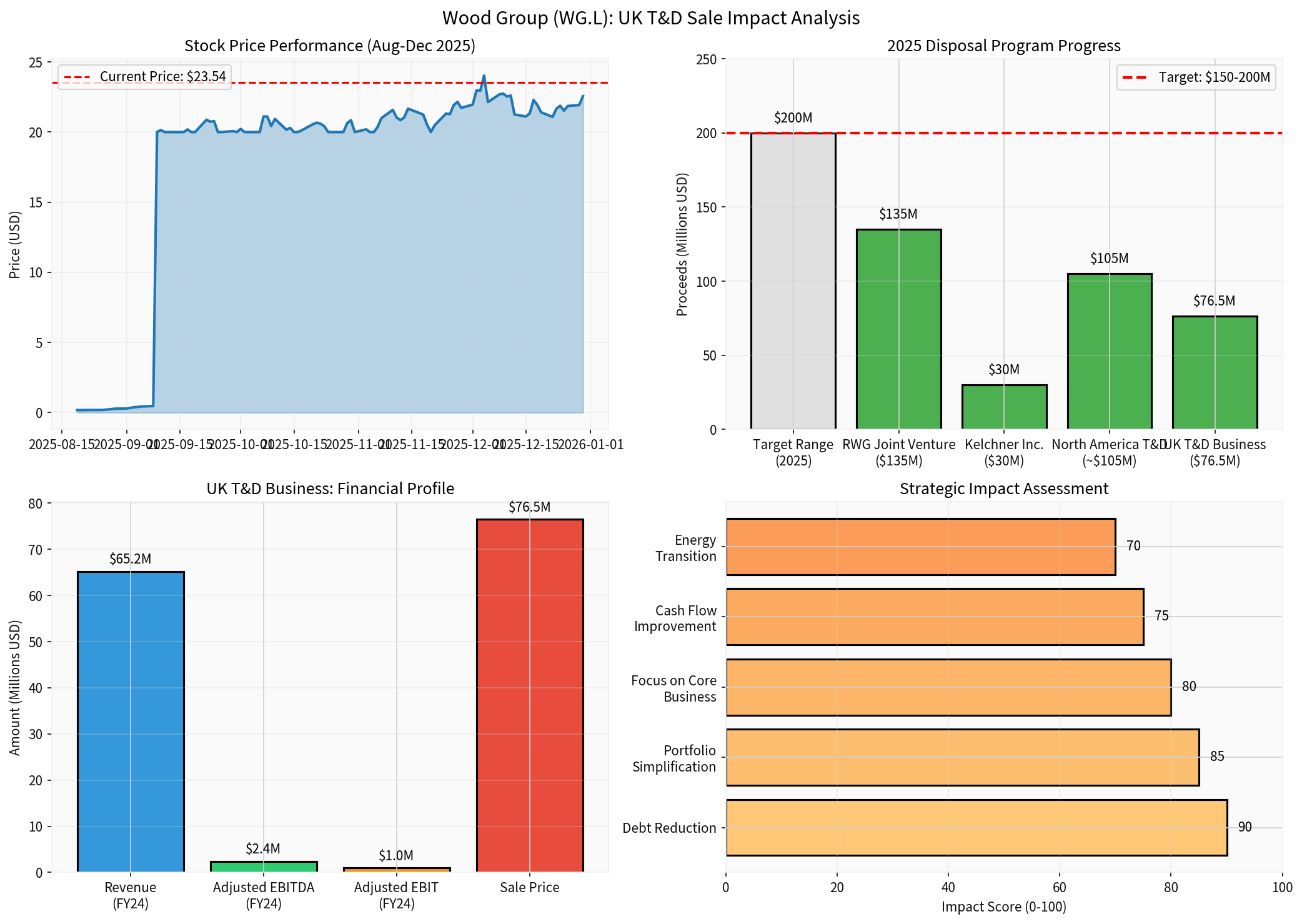
Wood Group’s sale of its UK Transmission & Distribution (T&D) business to United Infrastructure for £57.5 million ($76.5 million) represents a significant milestone in the company’s broader portfolio transformation strategy[1]. This transaction, combined with other disposals in 2025, has generated approximately $345 million in total proceeds—substantially exceeding the original target range of $150-200 million[2]. The strategic divestment is designed to strengthen Wood’s financial position, simplify its business portfolio, and accelerate its focus on core high-margin services within the energy transition theme.
Parameter |
Value |
|---|---|
Buyer |
UI Telecoms & Power Holdco Limited (United Infrastructure) |
Sale Price |
£57.5 million (~$76.5 million) |
Expected Completion |
December 31, 2025 |
FY24 Revenue |
$65.2 million |
FY24 Adjusted EBITDA |
$2.4 million |
FY24 Adjusted EBIT |
$1.0 million |
Net Assets (FY24) |
$(1.6) million |
Source: Company disclosures[1]
The UK T&D business provided engineering, procurement, construction, and installation services for overhead line and underground cable projects in the UK, serving Distribution Network Operators (DNOs)[3].
The UK T&D sale is part of Wood Group’s comprehensive disposal program targeting non-core businesses. In 2025 alone, the company has agreed to four major transactions:
- RWG Joint Venture:$135 million (sale to Siemens Energy)
- Kelchner Inc.:$30 million (U.S. civil construction services)
- North America T&D:~$105 million (sale to Qualus)
- UK T&D Business:$76.5 million (sale to United Infrastructure)[2]
The disposal program aligns with Wood’s strategy to:
- Exit lower-margin infrastructure services(T&D operations historically generated thin margins)
- Concentrate on core high-margin servicesin energy consulting, project management, and technical solutions
- Enhance exposure to energy transition marketsincluding renewables, carbon capture, hydrogen, and decarbonization[4]
- Reduce reliance on large-scale lump sum turnkey (LSTK) contractswhich carry higher execution risk[4]
By divesting UK and North American T&D assets, Wood is strategically reallocating capital to higher-growth regions, particularly:
- Middle East:Strong demand in Iraq and wider region (contracts up nearly 20% in 2025)[5]
- Emerging energy transition marketsacross 60+ countries globally[4]
- Current Net Debt:~$1.1 billion (as of 2024)[2]
- 2025 Expected Free Cash Flow:Negative $(150) million to $(200) million[2]
- Debt Classification:High risk per financial analysis[0]
- Immediate cash infusionof $76.5 million to reduce net debt by approximately 7%
- Proceeds utilization:Specifically earmarked for debt reduction and general corporate purposes[6]
- Debt-to-equity improvement:Supports deleveraging efforts amid challenging capital structure
With ~$345 million in total disposal proceeds (vs. $150-200 million target), Wood is positioned to:
- Offset the 2025 negative free cash flow entirely
- Maintain net debt at 2024 levels of ~$1.1 billion
- Create liquidity buffer for operational improvements[2]
- Annual revenue reduction:~$65.2 million (UK T&D contribution)[1]
- EBITDA reduction:~$2.4 million (minimal impact on consolidated profitability)[1]
- Capital structure:Sale of a business with negative net assets (-$1.6 million) improves balance sheet quality[1]
- Exit low-margin T&D services:Historically thin margins in infrastructure construction
- Portfolio mix improvement:Shift toward higher-margin consulting and technical services
- Simplification benefits:Reduced complexity, overhead, and working capital requirements
The UK T&D business generated
Metric |
Value |
Interpretation |
|---|---|---|
Market Cap |
$162.57 million | Severely depressed valuation |
Current Price |
$23.54 | Post-restructuring recovery from $0.18 low[0] |
P/E Ratio |
-1.97x | Negative earnings (loss-making) |
P/B Ratio |
0.06x | Trading at deep discount to book value |
ROE |
-3.01% | Negative return on equity[0] |
- Debt reduction of ~7%improves financial stability during restructuring
- Strategic clarityfrom accelerated portfolio simplification
- Focus on higher-growth, higher-margin segmentsmay justify improved multiple
- Cash generationfrom disposals exceeds expectations, demonstrating execution capability
- Loss of $65.2M revenue(though low-margin) reduces top-line
- Continued negative earningsuntil turnaround materializes
- High leverage persistsdespite disposals (net debt still ~$1B+)
- Execution riskin transitioning business model
The disposals, including UK T&D, support Wood’s target of
- Stabilization of legacy claims liabilities (~$150M over 3 years)
- Working capital normalization
- Margin expansion from portfolio simplification (~$60M annual savings from 2025)[4]
If successful, this turnaround could justify a significant valuation re-rating from current distressed levels.
The UK T&D sale accelerates Wood’s transformation into a
-
Core Business Concentration:
- Energy consulting and advisory services
- Project management for energy transition projects
- Technical solutions for decarbonization
- Digital and innovation-led services[4]
-
Geographic Prioritization:
- Middle East expansion:Strong growth in Iraq (contracts up nearly 20% in 2025)[5]
- Energy transition hubs:Renewables, hydrogen, carbon capture globally
- Selective presence:Maintaining operations only in high-return markets
-
Business Model Evolution:
- Reduced LSTK exposure:Lower risk, higher predictability
- Fee-based services:More stable, asset-light revenue streams
- Partnership-led growth:Collaborating rather than owning entire project lifecycle
Proceeds from disposals (including UK T&D) will support:
- Debt reduction(primary priority)
- Investment in digital solutionsand energy transition capabilities[4]
- Selective strategic acquisitionsin core focus areas
- Working capital stabilizationduring transition
- Transition disruption:Divesting multiple businesses simultaneously creates operational complexity
- Talent retention:Key employee departures during organizational restructuring
- Client relationships:Potential revenue attrition from dispositions
- Insufficient proceeds:Even with ~$345M in disposals, net debt remains elevated at ~$1.1B
- Cash flow pressure:Negative FCF in 2025 requires careful liquidity management
- Legacy liabilities:~$150M in claim costs over 3 years continues to strain cash flow[2]
- Energy transition timing:Pace of renewable energy adoption affects growth opportunities
- Competitive pressure:Established competitors in core consulting segments
- Macro volatility:Oil & gas price volatility impacts traditional client base
- Debt reduction remains criticalto stabilize balance sheet
- Focus on cash generationto achieve positive FCF in 2026 (as targeted)[2]
- Monitor executionof portfolio transition and margin improvement
- Successful delivery of positive FCFcould trigger valuation re-rating
- Proof of strategic transformationthrough revenue mix shift to energy transition
- Potential strategic alternativesincluding partnership or M&A if standalone execution falters
- Current valuation(P/B 0.06x) prices in significant distress, creating potential upside if turnaround succeeds
- Disposal executionhas exceeded expectations, demonstrating management credibility
- Key catalystsinclude 2026 positive FCF delivery and sustained margin expansion
- Employees:Focus on core segments offers clearer career path in high-growth areas
- Clients:Simplified portfolio may enable deeper expertise in energy transition
- Counterparties:Reduced leverage from disposals improves credit profile (though still high-risk)
Wood Group’s sale of its UK T&D business to United Infrastructure for $76.5 million represents a strategically prudent step in an ambitious portfolio transformation. The transaction, combined with other 2025 disposals totaling ~$345 million, provides immediate financial relief through debt reduction while positioning the company for sustainable growth in higher-margin energy transition services.
The
Ultimately, the UK T&D sale is a necessary component of Wood’s broader reinvention from a diversified energy services conglomerate to a focused, high-margin advisor in the global energy transition. The success of this strategy will determine whether current valuations represent a compelling opportunity or a value trap.
https://www.woodplc.com/news/latest-press-releases/2025/sale-of-uk-t-and-d-busines
https://www.woodplc.com/news/latest-press-releases/2025/business-update
https://unitedinfrastructure.com/news/acquisition-of-woods-uk-transmission-and-distribution-business/
https://matrixbcg.com/blogs/growth-strategy/woodplc
https://www.iraqinews.com/iraq/wood-sees-strong-iraq-demand-as-middle-east-awards-jump-nearly-20/
https://www.woodplc.com/news/latest-press-releases/2025/sale-of-north-america-t-and-d-to-qualus
数据基于历史,不代表未来趋势;仅供投资者参考,不构成投资建议
关于我们:Ginlix AI 是由真实数据驱动的 AI 投资助手,将先进的人工智能与专业金融数据库相结合,提供可验证的、基于事实的答案。请使用下方的聊天框提出任何金融问题。