Google Ironwood TPU Launch: AI Infrastructure Competition with Nvidia Intensifies
解锁更多功能
登录后即可使用AI智能分析、深度投研报告等高级功能
关于我们:Ginlix AI 是由真实数据驱动的 AI 投资助手,将先进的人工智能与专业金融数据库相结合,提供可验证的、基于事实的答案。请使用下方的聊天框提出任何金融问题。
相关个股
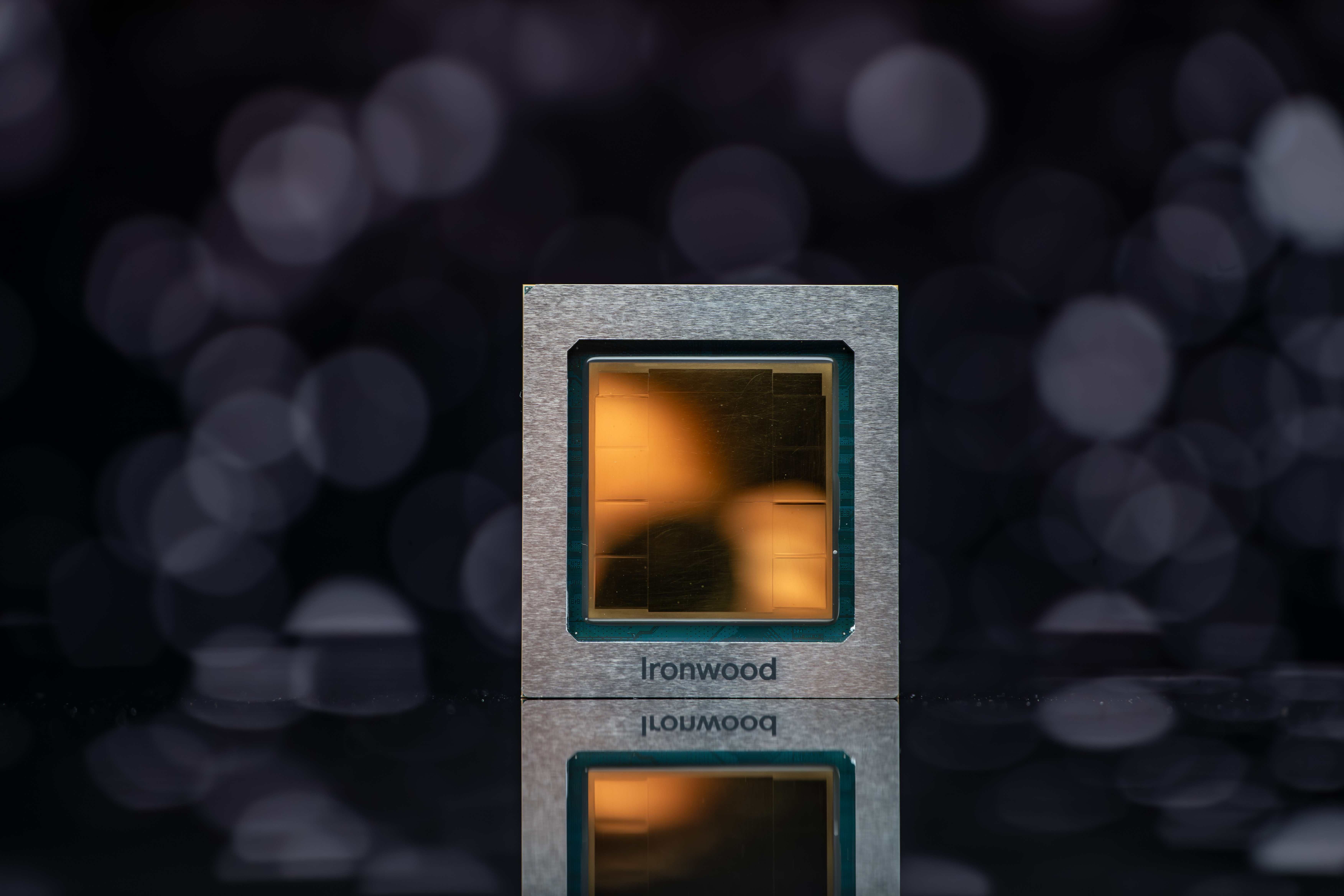
This analysis is based on the CNBC report [1] published on November 6, 2025, which reported Google’s launch of Ironwood, its seventh-generation Tensor Processing Unit. The announcement marks a significant escalation in the AI infrastructure competition between Google and Nvidia, with immediate market reactions reflecting the strategic importance of this development [0][1].
The Ironwood TPU represents Google’s most aggressive challenge yet to Nvidia’s dominance in AI training and inference markets. Key technical specifications include 4x faster performance than its predecessor (Trillium), 42.5 Exaflops of compute power when scaled to 9,216 chips, and 2x better performance-per-watt efficiency [1][2][3]. Google claims Ironwood pods deliver approximately 118x more computational power than Nvidia’s GB300 NVL72 system at the pod level, though direct architectural comparisons require careful consideration [3].
The market reaction revealed divergent investor sentiment: Google (GOOG) declined 0.38% to $283.67, while Nvidia (NVDA) experienced a more significant 3.42% drop to $188.52 [0]. This suggests investors may be pricing in competitive pressure on Nvidia’s market position while weighing broader market factors affecting Google’s stock.
Google’s Ironwood launch coincides with its aggressive cloud services expansion, with Q3 2025 Google Cloud revenue reaching $15.15 billion (34% YoY growth) [1]. The company has increased capital expenditure to $93 billion (up from $85 billion), reflecting massive investment in AI infrastructure [1]. CEO Sundar Pichai emphasized that AI infrastructure products represent “one of the key drivers of our growth over the past year” [1].
Critical validation comes from major customer commitments, particularly Anthropic’s plan to use up to 1 million Ironwood TPUs for its Claude model [1]. This represents one of the largest AI infrastructure deployments to date and signals strong enterprise confidence in Google’s custom silicon approach.
The Ironwood launch represents more than just hardware competition—it signifies a fundamental shift in AI infrastructure strategy. Google’s vertical integration approach (custom silicon + cloud platform) contrasts with Nvidia’s horizontal model (hardware sold to multiple cloud providers). This could reshape the competitive dynamics of the entire AI ecosystem.
While Ironwood’s technical specifications are impressive on paper, the true competitive impact will depend on the balance between hardware performance and software ecosystem maturity. Nvidia’s established CUDA ecosystem creates significant switching costs that may slow TPU adoption despite performance advantages.
Google’s ability to deploy Ironwood at massive scale (up to 9,216 chips per pod with 1.77 PB total memory) suggests potential cost advantages that could disrupt AI infrastructure pricing models [2][3]. However, the lack of public pricing information makes it difficult to assess the true economic impact on the market.
- General availability timeline and initial deployment challenges could delay market impact
- Software compatibility issues with existing AI frameworks may create adoption barriers
- Customer willingness to switch from established GPU ecosystems remains uncertain
- Supply chain constraints in semiconductor manufacturing could limit scalability
- Rapid pace of AI hardware innovation may shorten Ironwood’s competitive window
- Potential regulatory scrutiny regarding Google’s expanding AI infrastructure dominance
- Performance advantages could accelerate enterprise adoption of TPUs for specific workloads
- Improved performance-per-watt efficiency may appeal to environmentally conscious enterprises
- Google’s integrated cloud + hardware approach could create compelling total cost of ownership advantages
- Early mover advantage in inference-optimized hardware for large language models
- Potential to capture high-margin AI workloads from customers seeking alternatives to Nvidia
- Opportunity to establish TPU as industry standard for specific AI applications
Decision-makers should be aware of several information gaps that limit comprehensive analysis:
- Pricing Structure: No public pricing information available for Ironwood TPU instances
- Independent Benchmarks: Third-party performance validation not yet available
- Migration Costs: Limited information on transition costs from GPU to TPU ecosystems
- Software Ecosystem: Insufficient details on developer tooling and framework support
- Supply Capacity: No information on manufacturing constraints or availability timelines
Key indicators to watch in coming quarters include:
- Customer adoption metrics and workload migration patterns
- Independent performance benchmarking results
- AI infrastructure pricing trends across the market
- Nvidia’s competitive response and next-generation product announcements
- Google Cloud revenue growth and capital expenditure efficiency
The Ironwood launch occurs during a period of intense AI infrastructure investment, with major cloud providers racing to secure competitive advantages. Google’s 34% cloud revenue growth outpaces AWS’s 20% but trails Azure’s 40%, suggesting Ironwood could be a key differentiator in this competitive landscape [1].
数据基于历史,不代表未来趋势;仅供投资者参考,不构成投资建议
关于我们:Ginlix AI 是由真实数据驱动的 AI 投资助手,将先进的人工智能与专业金融数据库相结合,提供可验证的、基于事实的答案。请使用下方的聊天框提出任何金融问题。