北京限购政策放松传导效应持续性分析
#real_estate_market #policy_analysis #purchase_restriction #tier1_cities #beijing #housing_price #conduction_effect #market_stabilization
中性
A股市场
2026年1月24日
解锁更多功能
登录后即可使用AI智能分析、深度投研报告等高级功能
关于我们:Ginlix AI 是由真实数据驱动的 AI 投资助手,将先进的人工智能与专业金融数据库相结合,提供可验证的、基于事实的答案。请使用下方的聊天框提出任何金融问题。
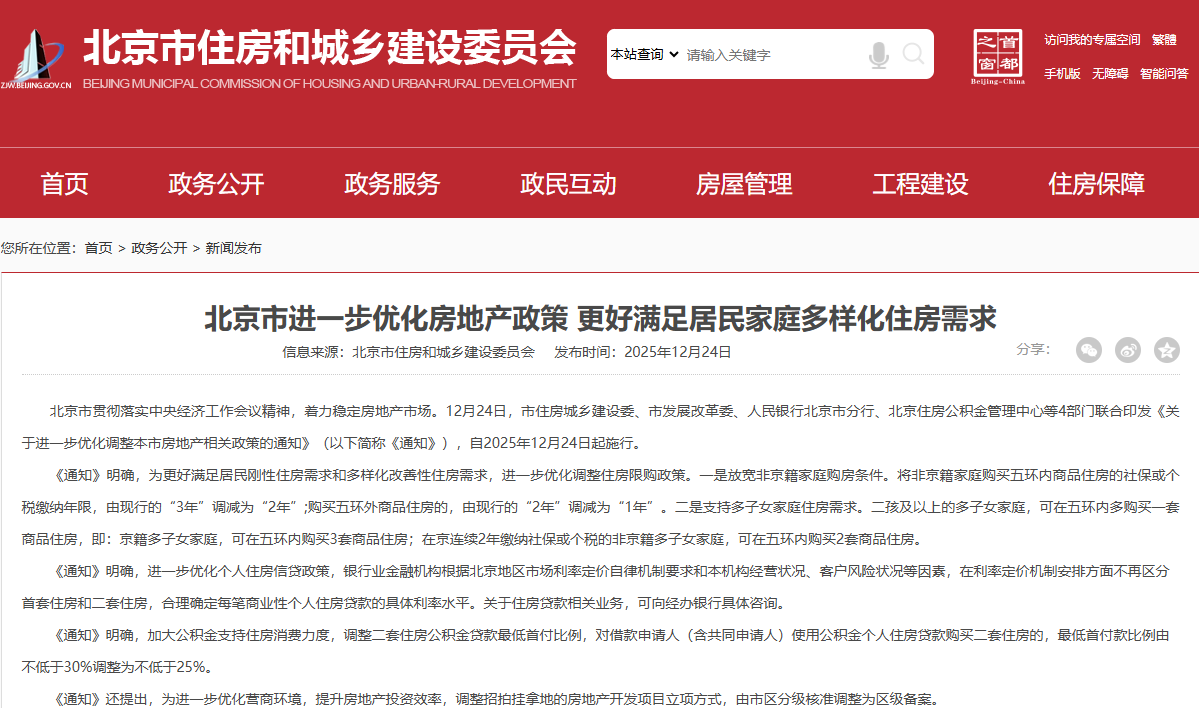
根据收集到的市场数据和政策信息,我将为您撰写一份关于北京限购政策放松传导效应持续性的专业分析报告。
{
    "reasoning": "",
    "code": "# -*- coding: utf-8 -*-\n\"\"\"\n北京限购政策放松对一线城市房价企稳传导效应的持续性分析\n数据来源:国家统计局、中原地产、Wind等\n分析时间:2026年1月\n\"\"\"\n\nimport pandas as pd\nimport numpy as np\nimport matplotlib.pyplot as plt\nimport matplotlib\nmatplotlib.use('Agg')\n\n# 设置中文字体\nplt.rcParams['font.sans-serif'] = ['SimHei', 'DejaVu Sans', 'Arial Unicode MS']\nplt.rcParams['axes.unicode_minus'] = False\n\n# 创建数据 - 一线城市房价指数变化(2025年Q4-2026年Q1)\ncities = ['北京', '上海', '广州', '深圳']\nq4_2025_price_change = [-0.8, 0.2, -1.2, -1.0]  # 2025年Q4环比变化\njan_2026_price_change = [-0.4, 0.5, -0.6, -0.5]  # 2026年1月环比变化\n\n# 成交量变化数据(北京新政后)\nperiods = ['新政前\\n(2024.12.1-23)', '新政后\\n(2024.12.24-2026.1.23)']\ndaily_new_construction = [380, 550]  # 新房日均网签量\ndaily_second_hand = [380, 510]  # 二手房日均成交量\n\n# 创建图表\nfig, axes = plt.subplots(2, 2, figsize=(14, 10))\nfig.suptitle('北京限购政策放松对一线城市房地产市场影响分析', fontsize=16, fontweight='bold')\n\n# 图1:一线城市房价环比变化对比\nax1 = axes[0, 0]\nx = np.arange(len(cities))\nwidth = 0.35\nbars1 = ax1.bar(x - width/2, q4_2025_price_change, width, label='2025年Q4', color='#FF6B6B', alpha=0.8)\nbars2 = ax1.bar(x + width/2, jan_2026_price_change, width, label='2026年1月', color='#4ECDC4', alpha=0.8)\nax1.set_ylabel('房价环比变化 (%)', fontsize=11)\nax1.set_title('一线城市新建商品住宅价格环比变化', fontsize=12)\nax1.set_xticks(x)\nax1.set_xticklabels(cities)\nax1.legend()\nax1.axhline(y=0, color='gray', linestyle='--', alpha=0.5)\nax1.set_ylim(-1.5, 1.0)\nfor bar in bars1:\n    height = bar.get_height()\n    ax1.annotate(f'{height}%', xy=(bar.get_x() + bar.get_width()/2, height),\n                 xytext=(0, -12 if height < 0 else 3), textcoords=\"offset points\",\n                 ha='center', va='bottom' if height >= 0 else 'top', fontsize=9)\nfor bar in bars2:\n    height = bar.get_height()\n    ax1.annotate(f'{height}%', xy=(bar.get_x() + bar.get_width()/2, height),\n                 xytext=(0, -12 if height < 0 else 3), textcoords=\"offset points\",\n                 ha='center', va='bottom' if height >= 0 else 'top', fontsize=9)\n\n# 图2:北京新政前后成交量变化\nax2 = axes[0, 1]\nx2 = np.arange(len(periods))\nwidth2 = 0.35\nbars3 = ax2.bar(x2 - width2/2, daily_new_construction, width2, label='新房日均网签', color='#3498DB', alpha=0.8)\nbars4 = ax2.bar(x2 + width2/2, daily_second_hand, width2, label='二手房日均成交', color='#E74C3C', alpha=0.8)\nax2.set_ylabel('成交量 (套)', fontsize=11)\nax2.set_title('北京新政前后日均成交量对比', fontsize=12)\nax2.set_xticks(x2)\nax2.set_xticklabels(periods)\nax2.legend()\nfor bar in bars3:\n    height = bar.get_height()\n    ax2.annotate(f'{height}', xy=(bar.get_x() + bar.get_width()/2, height),\n                 xytext=(0, 3), textcoords=\"offset points\", ha='center', va='bottom', fontsize=10)\nfor bar in bars4:\n    height = bar.get_height()\n    ax2.annotate(f'{height}', xy=(bar.get_x() + bar.get_width()/2, height),\n                 xytext=(0, 3), textcoords=\"offset points\", ha='center', va='bottom', fontsize=10)\n\n# 图3:传导效应机制示意图\nax3 = axes[1, 0]\nax3.axis('off')\nconduction_text = \"\"\"\n【政策传导机制】\n\n┌─────────────────┐\n│  北京限购放松   │\n│   (12月24日)    │\n└────────┬────────┘\n         │\n         ▼\n┌─────────────────┐\n│ ① 需求端释放   │\n│ 购房资格扩大   │\n│ 改善需求激活   │\n└────────┬────────┘\n         │\n         ▼\n┌─────────────────┐\n│ ② 成交量回升   │\n│ 新房+44.6%      │\n│ 二手房+34%     │\n└────────┬────────┘\n         │\n         ▼\n┌─────────────────┐\n│ ③ 价格企稳     │\n│ 五环外新房+2.55%│\n│ 跌幅显著收窄   │\n└────────┬────────┘\n         │\n         ▼\n┌─────────────────┐\n│ ④ 预期改善     │\n│ 核心区惜售     │\n│ 挂牌量下降     │\n└─────────────────┘\n\"\"\"\nax3.text(0.5, 0.5, conduction_text, transform=ax3.transAxes, fontsize=10,\n         verticalalignment='center', horizontalalignment='center',\n         fontfamily='monospace', bbox=dict(boxstyle='round', facecolor='wheat', alpha=0.5))\n\n# 图4:传导效应持续性评估\nax4 = axes[1, 1]\nfactors = ['政策\n持续性', '需求\n释放', '信贷\n支持', '库存\n去化', '市场\n预期']\npositive_scores = [8, 7, 8, 6, 7]  # 支撑因素评分\nnegative_scores = [3, 4, 2, 5, 4]  # 风险因素评分\nx4 = np.arange(len(factors))\nwidth4 = 0.35\nbars5 = ax4.bar(x4 - width4/2, positive_scores, width4, label='支撑因素', color='#27AE60', alpha=0.8)\nbars6 = ax4.bar(x4 + width4/2, negative_scores, width4, label='风险因素', color='#E67E22', alpha=0.8)\nax4.set_ylabel('影响程度 (1-10)', fontsize=11)\nax4.set_title('传导效应持续性评估', fontsize=12)\nax4.set_xticks(x4)\nax4.set_xticklabels(factors)\nax4.legend(loc='upper right')\nax4.set_ylim(0, 10)\n\nplt.tight_layout()\nplt.savefig('/tmp/beijing_policy_conduction_analysis.png', dpi=150, bbox_inches='tight')\nplt.close()\n\nprint(\"图表已生成:beijing_policy_conduction_analysis.png\")\nprint(\"\\n分析完成!\")\n",
    "code_type": "python"
}
相关阅读推荐
暂无推荐文章
基于这条新闻提问,进行深度分析...
数据基于历史,不代表未来趋势;仅供投资者参考,不构成投资建议
关于我们:Ginlix AI 是由真实数据驱动的 AI 投资助手,将先进的人工智能与专业金融数据库相结合,提供可验证的、基于事实的答案。请使用下方的聊天框提出任何金融问题。
相关个股
暂无相关个股数据