US Markets Decline on Job Loss Concerns and AI Valuation Fears
解锁更多功能
登录后即可使用AI智能分析、深度投研报告等高级功能
)
关于我们:Ginlix AI 是由真实数据驱动的 AI 投资助手,将先进的人工智能与专业金融数据库相结合,提供可验证的、基于事实的答案。请使用下方的聊天框提出任何金融问题。
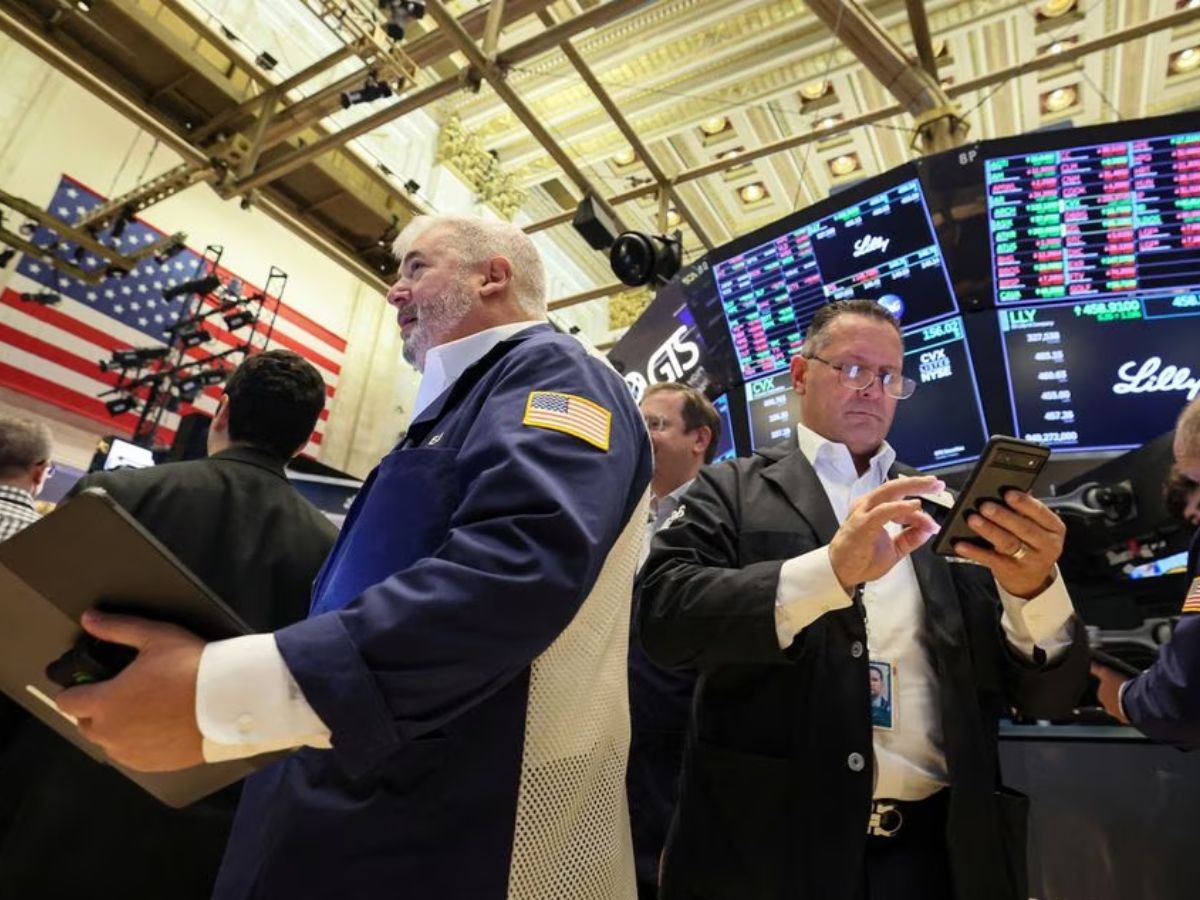
On November 6, 2025, U.S. equity markets experienced significant declines driven by converging concerns over labor market deterioration and artificial intelligence valuation excesses. The S&P 500 fell 1.1% to close at 6,720.31, while the technology-heavy Nasdaq Composite dropped 1.9% to 23,053.99 [0]. This broad-based market weakness reflected investor anxiety over multiple headwinds including rising layoffs, potential AI bubble risks, and economic data uncertainty due to the ongoing federal government shutdown.
The market decline was characterized by sector rotation toward defensive positions, with only Healthcare (+0.43%) and Real Estate (+0.09%) posting gains [0]. Technology stocks were particularly hard hit, declining 1.58%, alongside significant losses in Industrials (-2.33%), Consumer Cyclical (-2.14%), and Financial Services (-1.83%) [0]. This pattern suggests investors were reducing exposure to economically sensitive sectors amid growing recession concerns.
The primary catalyst for market concern was the Challenger, Gray & Christmas report revealing
The technology sector emerged as a significant contributor to layoffs, with 33,281 cuts in October - nearly six times September’s level [1][2]. Warehousing followed with 47,878 cuts, up dramatically from just 984 in September [1]. Cost-cutting was cited as the primary reason for 50,437 layoffs, while AI adoption was the second-most cited factor, responsible for 31,039 job cuts [1].
Wall Street leadership has increasingly voiced concerns about AI stock valuations reaching unsustainable levels. Morgan Stanley CEO Ted Pick warned of a potential 10-15% equity market drawdown, while Goldman Sachs CEO David Solomon stated “Technology multiples are full” [4]. JPMorgan CEO Jamie Dimon has previously warned of significant correction risk within 6 months to 2 years [4].
The AI investment frenzy has drawn comparisons to the dot-com bubble, with Citigroup estimating $2.8 trillion in AI-related infrastructure spending by tech giants through 2029 [4]. This massive capital commitment has raised questions about potential overinvestment and subsequent correction risks.
The ongoing federal government shutdown, now in its fifth week, has significantly disrupted economic data collection and reporting. The Bureau of Labor Statistics has suspended all operations, delaying crucial monthly jobs reports and creating uncertainty about actual labor market conditions [3]. This data vacuum has forced markets to rely on alternative indicators like ADP employment data, which while showing strong correlation (R² = 0.9817) with BLS data, cannot fully substitute official government statistics [3].
-
Escalating Layoff Trend: If announced layoffs translate to actual job losses exceeding 1.1 million annually, consumer spending could decline significantly, potentially triggering broader economic weakness.
-
AI Market Correction: A sharp correction in AI-related stocks could trigger broader market contagion, particularly affecting technology-heavy indices that have driven recent market gains.
-
Prolonged Data Uncertainty: Extended government shutdown could lead to increased market volatility and policy uncertainty as investors operate with incomplete economic information.
-
The timing of layoffs in Q4 2025 is unusual, as companies typically avoid announcing job cuts before holidays [1], suggesting urgency in cost-cutting measures.
-
AI-driven job cuts may represent structural workforce changes rather than cyclical adjustments, potentially indicating longer-term shifts in employment patterns.
-
The convergence of labor market weakness and valuation concerns could compound downside risks, creating a negative feedback loop between economic fundamentals and market sentiment.
Key indicators to watch include weekly jobless claims, ADP employment reports, AI stock valuation trends, Federal Reserve responses to labor market concerns, and the timeline for government shutdown resolution [0].
The November 6, 2025 market decline reflects growing investor concerns over multiple interconnected risks. The labor market shows clear deterioration with October job cuts reaching 22-year highs, while AI valuations appear increasingly stretched according to major financial institution leaders. The ongoing government shutdown has created significant data uncertainty, making it difficult to assess actual economic conditions versus announced corporate actions.
Technology companies have emerged as both victims and contributors to current market dynamics, with the sector experiencing significant layoffs while also facing valuation pressure. The unusual timing of Q4 job cuts suggests companies may be pre-emptively positioning for potential economic weakness, while AI adoption represents both a cost-cutting driver and potential source of future productivity gains.
Market participants should monitor the resolution of the government shutdown for restored data visibility, track actual versus announced job cuts for economic impact assessment, and watch AI stock performance for potential contagion effects to broader market segments.
数据基于历史,不代表未来趋势;仅供投资者参考,不构成投资建议
关于我们:Ginlix AI 是由真实数据驱动的 AI 投资助手,将先进的人工智能与专业金融数据库相结合,提供可验证的、基于事实的答案。请使用下方的聊天框提出任何金融问题。