Market Disconnect: Why Stocks Thrive While Consumer Spending Falters
#economy #market analysis #wealth inequality #consumer spending #AI #K-shaped recovery #stock market #technology sector #consumer sentiment #market disconnect
中性
综合市场
2025年11月16日
解锁更多功能
登录后即可使用AI智能分析、深度投研报告等高级功能
关于我们:Ginlix AI 是由真实数据驱动的 AI 投资助手,将先进的人工智能与专业金融数据库相结合,提供可验证的、基于事实的答案。请使用下方的聊天框提出任何金融问题。
Reddit Factors
Reddit users on r/stocks and related investing forums have identified several key explanations for the market-consumer disconnect:
-
Stock-Economy Decoupling: Multiple users argue that stocks have been fundamentally decoupled from the real economy for years, with market performance driven by factors unrelated to average consumer spending patterns[1]
-
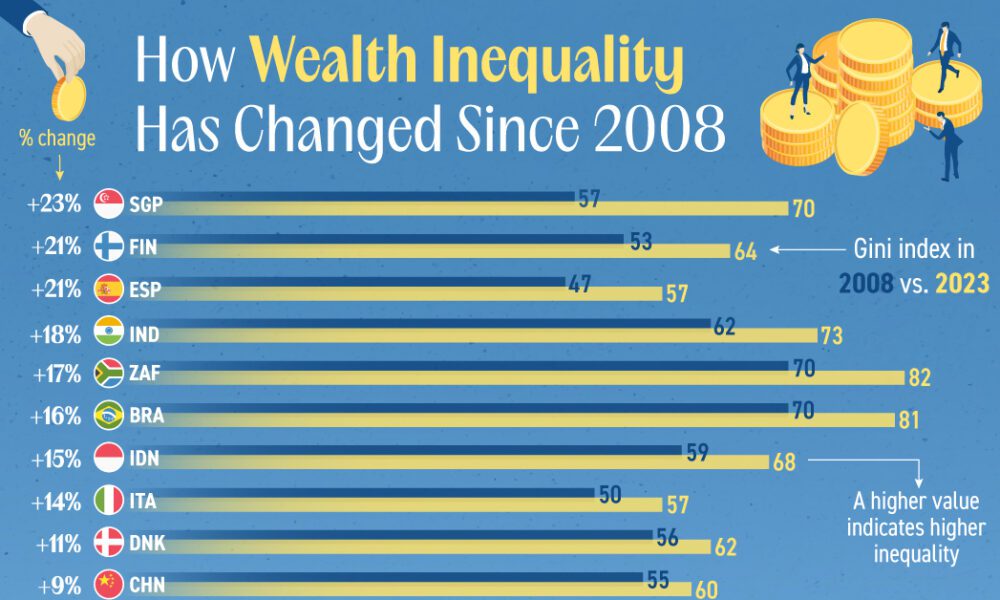
Wealth Inequality Dynamics: Users emphasize that the top 10-20% of households control the majority of market activity and consumer spending, creating a bifurcated economy where market gains don’t reflect broader economic conditions[1]
-
AI and Tech Dominance: Commenters identify AI capital expenditure and technology companies as the primary market drivers, noting that only AI-related stocks are performing well while consumer-facing stocks like Disney and Starbucks remain flat[1]
-
K-Shaped Recovery: Users describe a two-tier economy where wealthy consumers continue spending on travel and discretionary items while working-class households reduce tipping, face layoffs, and cut back on non-essential purchases[1]
-
Sector-Specific Performance: Some users point to counter-evidence like Expedia’s strong Q3 2025 earnings, suggesting travel spending remains robust even as other consumer sectors struggle[1]
Research Findings
Market and economic data confirm the Reddit observations while providing additional context:
Market Drivers
- S&P 500 Q3 2025 earnings grew 10.7% year-over-year, marking the ninth consecutive quarter of expansion[2]
- Technology sector earnings surged 26.5%, with AI-focused “Magnificent 7” companies propelling major indices to record highs[2]
- Forward 12-month P/E ratio stands at 22.9x, above five-year and ten-year averages, indicating elevated valuations[2]
- Sector performance varies dramatically: Communication Services (+22.37% YTD) and Information Technology (+21.88% YTD) significantly outperform Consumer Staples (+0.11% YTD)[2]
Consumer Stress Signals
- University of Michigan Consumer Sentiment Index dropped to 50.3 in November 2025, near the lowest level since 1978[3]
- 71% of respondents expect unemployment to rise, with 43% perceiving personal job loss risk[4]
- Long-term unemployment rose sharply from 21.5% to 25.7% of total unemployed[4]
- Buying conditions for big-ticket goods are at their worst since mid-2022[5]
Two-Tier Economy Reality
- The richest 10% of Americans now account for 50% of all consumer spending[6]
- Retail same-store sales increased 5.7% year-over-year in October 2025, but growth was driven primarily by price increases rather than unit volumes[7]
- Travel industry remains strong while other discretionary sectors face significant pressure[8]
Synthesis
The Reddit community’s analysis aligns closely with empirical data, revealing a structural market disconnect driven by several factors:
Agreement Points
- Both Reddit users and research data confirm that AI and technology sectors are the primary market drivers, not broad consumer spending
- The K-shaped recovery narrative is supported by data showing wealthier households driving disproportionate market and consumer activity
- Sector-specific performance disparities validate observations that only certain segments of the economy are thriving
Key Insights
The market’s resilience despite consumer stress reflects a fundamental shift in what drives stock valuations. Corporate earnings growth, particularly in technology and AI, has decoupled from Main Street economic health. This creates a situation where:
- Market Performance ≠ Economic Health: Record stock highs coexist with near-record low consumer sentiment
- Wealth Concentration Effects: A small percentage of high-net-worth individuals can sustain both market valuations and consumer spending statistics
- Sector Divergence: Technology and AI investments create wealth effects that don’t translate to broader economic prosperity
Risks & Opportunities
Risks
- Valuation Stretched: Forward P/E of 22.9x suggests markets may be vulnerable to corrections if AI earnings growth disappoints[2]
- Consumer Debt Stress: Rising credit card debt among lower-income households could trigger broader economic weakness[4]
- Policy Uncertainty: Government shutdowns and geopolitical risks could impact corporate earnings and investor sentiment[2]
Opportunities
- AI Infrastructure Plays: Continued AI capital expenditure could benefit semiconductor, cloud computing, and data center companies[2]
- Luxury and Travel: High-end consumer spending remains resilient, benefiting premium brands and travel companies[8]
- Financial Services: Wealth management and investment firms may benefit from continued market participation by high-net-worth individuals
Investment Implications
The current environment favors sector-specific investing over broad market exposure. Technology and AI-related companies continue to show strong fundamentals, while consumer discretionary stocks face headwinds from reduced spending among middle and lower-income households. Investors should consider the two-tier economy structure when making allocation decisions, focusing on companies serving high-net-worth consumers or participating in AI infrastructure buildout.
参考来源
相关阅读推荐
暂无推荐文章
基于这条新闻提问,进行深度分析...
数据基于历史,不代表未来趋势;仅供投资者参考,不构成投资建议
关于我们:Ginlix AI 是由真实数据驱动的 AI 投资助手,将先进的人工智能与专业金融数据库相结合,提供可验证的、基于事实的答案。请使用下方的聊天框提出任何金融问题。
相关个股
暂无相关个股数据