Tesla's Physical AI Pivot: Strategic Analysis
解锁更多功能
登录后即可使用AI智能分析、深度投研报告等高级功能

关于我们:Ginlix AI 是由真实数据驱动的 AI 投资助手,将先进的人工智能与专业金融数据库相结合,提供可验证的、基于事实的答案。请使用下方的聊天框提出任何金融问题。
相关个股
Based on my comprehensive analysis of Tesla’s strategic pivot toward “physical AI,” I will now provide a detailed assessment of how this transformation impacts the company’s valuation and competitive positioning.
Tesla, Inc. (NASDAQ: TSLA) stands at a critical inflection point as CEO Elon Musk orchestrates a fundamental strategic shift from a pure-play electric vehicle manufacturer toward a diversified “physical AI” technology company encompassing autonomous vehicles, humanoid robotics, and AI-optimized energy systems. This pivot represents both an ambitious expansion of Tesla’s total addressable market (TAM) and a significant reimagining of the company’s value proposition. The market is currently pricing Tesla at
The Q4 2025 earnings report, released on January 28, 2026, underscores this strategic narrative: while core automotive revenues face pressure with full-year sales declining approximately 3% amid intensifying EV competition, Tesla’s AI and robotics initiatives are positioned as the primary growth engines for the next decade [1][2]. This earnings beat ($0.50 EPS vs. $0.45 estimate on $24.78B revenue) was achieved largely through energy segment strength and AI narrative momentum, not traditional automotive execution.
CEO Elon Musk has articulated a comprehensive vision for Tesla as a “physical AI” company—a distinction from pure software AI companies that focuses on AI systems that interact with and manipulate the physical world. This encompasses three core pillars:
Tesla’s Full Self-Driving (FSD) technology and planned robotaxi network represent the most mature component of this strategy. The company has accumulated billions of miles of driving data from its fleet, providing a significant advantage in training autonomous driving algorithms. Musk has stated that robotaxis could eventually account for a substantial portion of Tesla’s revenue, with the TAM estimated at
The Optimus humanoid robot program represents Tesla’s most ambitious and speculative initiative. Musk has claimed that Optimus could account for
Tesla’s energy generation and storage segment (12.2% of Q3 FY2025 revenue) is increasingly being positioned as an AI-enabled business rather than a traditional energy equipment supplier. AI-optimized grid management, home energy systems, and large-scale battery storage leverage Tesla’s AI capabilities for predictive optimization. This segment recorded
Tesla has signaled a significant step-up in capital spending for 2026, with approximately
Tesla’s current market capitalization of
| Metric | Tesla | Toyota | Ford | Auto Industry Avg |
|---|---|---|---|---|
| P/E Ratio | 263.69x |
9.2x | 12.5x | ~10-15x |
| P/S Ratio | 14.97x |
0.9x | 0.3x | ~0.5-1.0x |
| P/B Ratio | 17.37x |
1.2x | 1.0x | ~1.5-2.5x |
| EV/EBITDA | 90.59x |
6.5x | 8.2x | ~6-10x |
The valuation disconnect between Tesla and traditional automakers is stark. Tesla trades at approximately
My discounted cash flow analysis reveals substantial gap between Tesla’s current stock price and intrinsic value under various scenarios [0]:
| Scenario | Fair Value | Premium/(Discount) to Current |
|---|---|---|
| Conservative | $144.19 | -66.5% |
| Base Case | $150.79 | -65.0% |
| Optimistic | $193.39 | -55.1% |
| Probability-Weighted | $162.79 | -62.2% |
- Revenue Growth: 32.7% (historical 5-year CAGR)
- EBITDA Margin: 16.7%
- Terminal Growth Rate: 2.5%
- WACC: 17.2% (reflecting Tesla’s high beta of 1.83)
- Cost of Equity: 17.3%
The substantial discount between current price ($430.46) and DCF-derived fair values ($144-$193) indicates that Tesla’s valuation is heavily dependent on the successful execution of the physical AI pivot. Traditional automotive cash flows, projected using historical averages, simply cannot justify the current stock price.
The analyst community remains deeply divided on Tesla’s valuation, reflecting uncertainty about the physical AI strategy’s success [0][2]:
| Rating | Count | Percentage |
|---|---|---|
| Buy | 30 | 37.5% |
| Hold | 33 | 41.2% |
| Sell | 17 | 21.2% |
- Consensus Target: $491.50(+14.2% from current)
- Target Range: $300.00 - $600.00
- Analyst Price Targets Range: $25 - $630[2]
This wide range ($605 spread) underscores the extreme uncertainty surrounding Tesla’s fundamental value proposition. The analyst community is essentially betting on binary outcomes: either Tesla successfully transforms into a physical AI leader with multi-trillion dollar market opportunities, or the valuation collapses toward traditional automotive multiples.
Tesla’s competitive positioning against traditional automakers reveals a bifurcated story:
-
FSD Data Advantage: Tesla’s fleet of vehicles collecting real-world driving data creates an insurmountable moat for competitors. With over 5 million vehicles on the road globally collecting training data, Tesla possesses the largest autonomous driving dataset in the industry.
-
Vertical Integration: Tesla’s control of the entire value chain—from semiconductor design (Dojo chip) to manufacturing to software—provides cost advantages and faster iteration cycles.
-
Brand & Consumer Appeal: Tesla maintains strong brand equity and consumer desire, particularly in premium segments, despite increased competition.
-
Software Revenue Potential: The transition to software-as-a-service revenue models (FSD subscriptions) offers higher margins and recurring revenue streams unavailable to traditional automakers.
-
Scale Disadvantage: Toyota (10+ million annual vehicle sales) and Volkswagen significantly outscale Tesla, providing manufacturing cost advantages and dealer networks.
-
Profitability Gap: Tesla’s operating margin has compressed to4.74%(TTM) and5.8%in Q4 2025, compared to Toyota’s historical operating margins of 7-10% [0][1].
-
Legacy Auto Resilience: Traditional automakers have proven more adaptable than expected, with accelerating EV programs and established dealer networks providing stability.
Tesla’s physical AI pivot positions it as a competitor not only to automakers but also to pure-play AI and robotics companies:
Waymo (estimated $45B valuation within Alphabet) has deployed the most advanced commercial robotaxi service in Phoenix, San Francisco, Los Angeles, and Austin. However, Waymo’s approach—using expensive LiDAR sensors and high-definition maps—has proven capital-intensive and slow to scale. Tesla’s vision-based, camera-only approach offers lower per-vehicle costs but requires more sophisticated AI software.
Humanoid robotics is a nascent market with multiple players including Boston Dynamics, Agility Robotics, and 1X Technologies. Tesla’s advantage lies in manufacturing scale, AI software capabilities (leveraging FSD development), and vertical integration. However, Tesla lacks the specialized robotics expertise of established players.
Tesla’s investment in xAI ($2B) and the integration of Grok AI capabilities into its vehicles and robots creates synergies unavailable to pure automotive competitors. This access to frontier AI models provides potential advantages in natural language understanding and general AI capabilities [3].
The physical AI thesis is predicated on Tesla successfully commercializing technologies that remain unproven at scale:
-
FSD Regulatory Hurdles: Full autonomous driving faces significant regulatory barriers. While Tesla’s “supervised FSD” approach bypasses some regulatory requirements, the path to unsupervised robotaxi operations requires regulatory approval that may be years away.
-
Optimus Manufacturing Complexity: Mass-producing humanoid robots presents unprecedented manufacturing challenges. The precision, dexterity, and cost requirements for commercially viable humanoid robots remain unproven.
-
AI Talent & Infrastructure: Competing with specialized AI companies for talent and building the infrastructure necessary for frontier AI development requires sustained investment and expertise.
-
EV Market Saturation: Tesla’s core automotive business faces intensifying competition, with Chinese automakers (BYD, NIO, XPeng) and legacy automakers (Volkswagen, GM, Ford) launching competitive EV models. Tesla’s EV market share is declining in key markets.
-
Autonomous Driving Competition: Waymo, Cruise (GM), Mobileye, and traditional automakers are investing billions in autonomous driving, potentially eroding Tesla’s first-mover advantage.
-
Economic Sensitivity: Tesla’s vehicles remain premium-priced products sensitive to economic cycles. A recession would impact demand for high-margin vehicles.
Tesla’s current valuation (263x P/E) leaves no margin for error. Even minor execution failures or competitive setbacks could trigger substantial multiple compression. The DCF analysis suggests a 60%+ downside if the physical AI thesis fails to materialize.
Tesla’s stock is currently trading in a
| Indicator | Value | Signal |
|---|---|---|
| MACD | No cross | Bearish |
| KDJ | K:47.1, D:50.3, J:40.5 | Bearish |
| RSI (14) | Normal range | Neutral |
| Beta | 1.83 | High volatility |
- Support: $423.41
- Resistance: $439.81
The stock has declined
The physical AI thesis could prove correct, with Tesla capturing substantial market share in:
- Robotaxi: 15% global market share = $75B revenue potential
- Optimus: 10% humanoid robot market = $30B revenue potential
- FSD Software: 30% subscription market = $30B recurring revenue
- Energy: AI-optimized systems = $40B revenue
Combined with continued automotive growth, Tesla could achieve
The physical AI thesis could fail to materialize due to:
- Regulatory barriers to autonomous driving
- Failure to commercialize Optimus profitably
- Intensifying EV competition eroding margins
- AI talent deficit relative to specialized AI companies
- Valuation collapse as market reverts to automotive multiples
Based on my comprehensive analysis, I assign a
-
Valuation Concern: The current stock price ($430.46) represents a 60%+ premium to fair value under reasonable DCF scenarios. The market is pricing in perfection from the physical AI strategy.
-
Near-Term catalysts: Q4 2025 earnings beat provides short-term support. Optimus demonstrations and FSD improvements could drive sentiment higher.
-
Long-Term Uncertainty: The physical AI thesis requires 3-5 years to prove or disprove. Investors must be comfortable with binary outcomes.
-
Risk Management: Given high beta (1.83) and valuation risk, position sizing should be conservative. Consider covered call strategies to generate income while maintaining exposure.
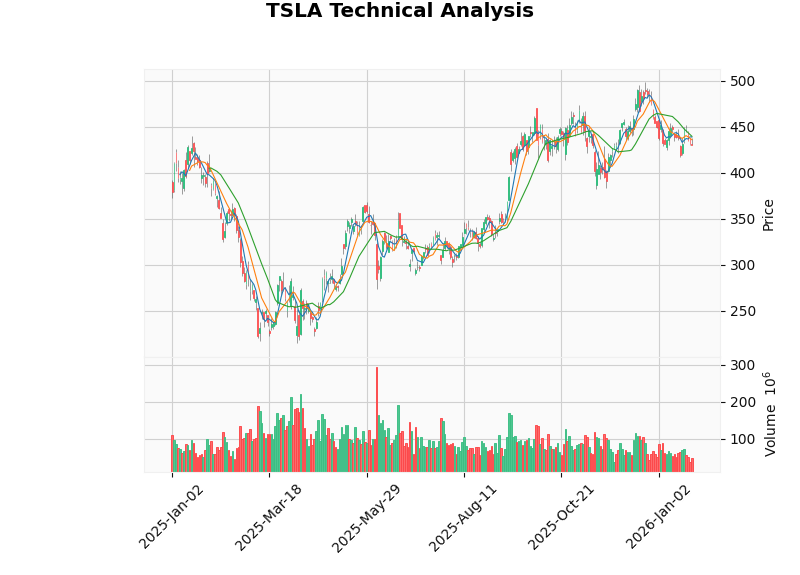
Figure 1: Tesla stock price with 20-day and 50-day moving averages, technical indicators, and key support/resistance levels [0]

Figure 2: Comprehensive Tesla analysis dashboard including price performance, revenue breakdown, DCF scenarios, analyst targets, and competitive positioning
-
Strategic Pivot: Tesla’s physical AI pivot represents a fundamental reimagining of the company from an automaker to an AI/robotics company. Success requires Tesla to execute in three highly competitive markets: autonomous vehicles, humanoid robotics, and AI-optimized energy.
-
Valuation Disconnect: Tesla trades at 263x P/E versus ~10x for traditional automakers. This premium is justified only if the physical AI thesis succeeds. DCF analysis suggests 60%+ downside if execution fails.
-
Execution Critical: The next 24 months are pivotal. Key milestones include FSD regulatory progress, Optimus production capabilities, and robotaxi commercial deployment.
-
Competitive Positioning: Tesla has advantages in data scale, vertical integration, and AI infrastructure, but faces formidable competition from Waymo (autonomous driving) and established robotics companies (humanoid robots).
-
Investment Approach: Given the binary nature of the investment thesis, investors should maintain small position sizes, use risk management strategies (stop-losses, options), and monitor execution milestones carefully.
[0]金灵API数据 - Tesla Company Overview, Real-Time Quote, Technical Analysis, Financial Analysis, and DCF Valuation
[1] WebProNews - “Tesla’s Earnings Pivot: AI Bets Eclipse Auto Slump” (https://www.webpronews.com/teslas-earnings-pivot-ai-bets-eclipse-auto-slump/)
[2] Intellectia.ai - “Tesla TSLA Stock Forecast 2026 - AI & Robotaxi Pivot” (https://intellectia.ai/blog/tesla-tsla-stock-forecast-2026-robotaxi-ai)
[3] TechCrunch - “Tesla invested $2B in Elon Musk’s xAI” (https://techcrunch.com/2026/01/28/tesla-invested-2b-in-elon-musks-xai/)
[4] The Motley Fool - “Tesla Stock Investors Just Got Good News From CEO Elon Musk” (https://www.fool.com/investing/2026/01/28/tesla-stock-investors-good-news-elon-musk-robotaxi/)
[5] U.S. Securities and Exchange Commission - Tesla 10-K Filing (https://www.sec.gov/Archives/edgar/data/1318605/000162828025003063/tsla-20241231.htm)
数据基于历史,不代表未来趋势;仅供投资者参考,不构成投资建议
关于我们:Ginlix AI 是由真实数据驱动的 AI 投资助手,将先进的人工智能与专业金融数据库相结合,提供可验证的、基于事实的答案。请使用下方的聊天框提出任何金融问题。